
Sustainability in the LUBS curriculum
In 2025, Student Sustainability Champion Prakriti Pannu launched a faculty-wide project to uncover how sustainability is being woven into the LUBS curriculum. Explore these real-world examples to get inspired and see how our staff are leading the way.
Discovering My Path
How a Simple Classroom Activity Changed My Perspective
MSc Business Analytics and Decision Sciences
The moment I entered the classroom, I knew this wouldn’t be just another Seminar. Large sheets of paper were spread across the tables, colourful markers sat in the middle, and a buzz of curiosity filled the room.
Our task? To map out sustainability ideas, drawing connections between climate change, business strategies, and social impact.
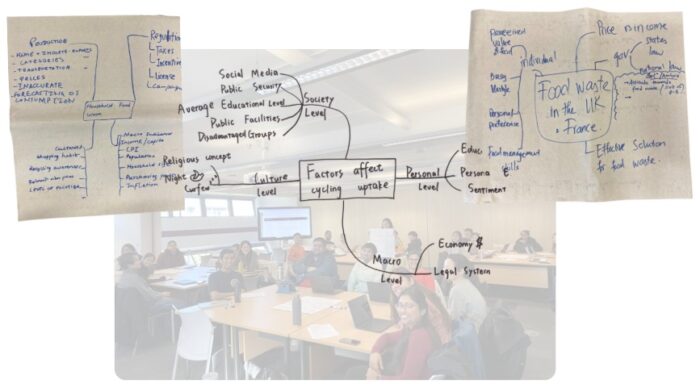
In this hands-on session, we used large sheets of paper, markers, and teamwork to visually connect a system of things around one sustainability real life Scenario. We started with a central theme and branched out, linking to business strategies, environmental policies, social justice, and more. Through collaboration and discussion, we uncover how everything is interconnected.
Why This Activity Stuck With Me
Unlike traditional lectures, this activity made me feel actively involved in learning rather than just absorbing information. Here’s what I took away from it:
- It made sustainability real
Seeing how everything is connected helped me understand that small actions have big impacts. - It encouraged me to think critically
Instead of just memorizing facts, I analyzed how sustainability affects businesses and individuals. - It sparked discussions that mattered
Hearing different perspectives from classmates made me rethink my own views. - It gave me practical insight
I realized that no matter what career path I take, sustainability will be a key factor in future business decisions.
If you’ve ever felt that sustainability is just a distant, complex issue, this type of activity will change your mind. It helps you see the bigger picture, makes learning interactive, and pushes you to think beyond the obvious.
From Coursework to Career Confidence
How One Assignment Sharpened My Real-World Skills
MSc Business Analytics and Decision Sciences
When I began the module, I expected the usual academic tasks. But what I received was an assignment that mirrored the complexity and pressure of real consultancy work.
The brief was to evaluate a high-stakes international acquisition for SustainVolt, a renewable energy company aiming to break into the East-Asian market of Jinhan through battery storage technology.
I had to assess whether acquiring a Chilean battery tech firm, VLBTech, would make sense not just from a financial perspective, but in terms of market impact, assumptions, risk, and even cultural alignment.
What I Actually Gained
This assignment was a masterclass in how to think like a consultant critically, strategically, and responsibly. It demanded more than academic theory and it gave me a set of skills that I’ve already used in a real-world contexts during interviews:
- Problem framing
I learned how to break down a complex, ambiguous business challenge into a structured opportunity statement clarifying goals, stakeholders, and constraints. - Analytical reasoning
Mapping assumptions and linking them to required data sharpened my ability to think logically and design practical, evidence-driven solutions. - Data sourcing with ethics
For each assumption, I had to decide what information was relevant, where I could find it, and whether accessing it raised ethical questions. This mirrored the real-life due diligence process. - Cultural sensitivity
Even as a numbers-driven analyst, I had to consider human dynamics, how cultural differences between the UK, Chile, and Jinhan could affect the success of a cross-border acquisition.
What surprised me most was how directly applicable these skills turned out to be. I’ve found that I now approach everyday tasks with a more structured, evaluative mindset. This assignment helped me move from being just a data technician to becoming an actual problem-solver.
This wasn’t just about completing a piece of coursework, it was about developing a consultant’s toolkit. Critical thinking. Structured analysis. Strategic framing. Cultural awareness. These are skills I’ll carry with me long after graduation.

Stepping into the Brief
How a Sustainability Campaign Made Me Rethink Marketing
MSc Marketing and Management
We were given a live brief to create a marketing campaign promoting sustainability. The challenge was to design a creative, persuasive campaign encouraging reduced plastic use for a real-world client. Unlike any assignment I’d done before, this wasn’t just about selling a product, it was about influencing behaviour and creating positive impact.
Our team had to think critically about everything from messaging and tone to the ethical implications of the campaign. We researched sustainable packaging, audience attitudes toward plastic use, and ways to make the campaign both impactful and realistic. We even explored how digital platforms could amplify our message while keeping the environmental footprint low.
Why I valued this activity
This campaign brief was more than just an academic exercise, it showed me how marketing can be used as a force for good.
- It made sustainability feel practical
I saw how marketing decisions directly affect social and environmental outcomes. - It pushed my creativity
We had to communicate urgency without fearmongering, and design ethically while staying on brand. - It boosted my confidence
Presenting our campaign in class, and getting feedback on both strategy and sustainability, felt like real industry preparation. - A Step Toward Employability
This activity helped me develop the kind of strategic thinking employers value. I now feel ready to work on purpose-driven campaigns and bring sustainability into my professional toolkit.
If you want to make your learning feel relevant and real, projects like this are invaluable. They challenge you to think bigger and act with intention. I walked away feeling inspired, more skilled, and better prepared to shape a career where marketing and sustainability go hand in hand. During job interviews, I’ve been able to talk about this experience as proof that I understand not just marketing but responsible marketing.
As a lecturer, one of the most significant contributions that I can make is to teach and hopefully educate, inspire and motivate students to feel that they too have agency to address climate change.